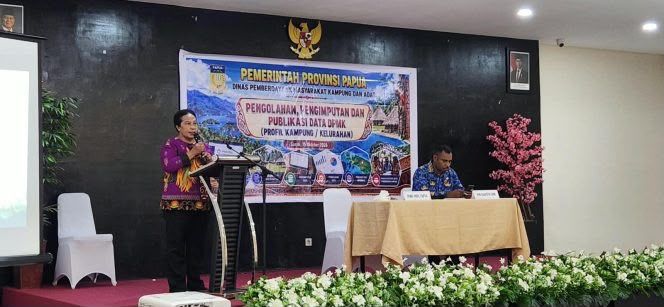
Sarmi – Accurate data is more than just a collection of numbers on paper; it serves as a vital “compass” that guides the direction of regional development. Adhering to this principle, the Papua Province Department of Village and Customary Community Empowerment (DPMK) officially launched an initiative for the processing, inputting, and publication of DPMK data for the 2026 fiscal year, held in Sarmi on Thursday, October 15, 2026.
This strategic program spans five months, from August to December 2026. It represents a major step toward addressing a classic development challenge in Papua: the scarcity of up-to-date data that truly reflects conditions at the grassroots level.
The Head of the Papua Province DPMK, Markus M. E. Olua, S.Sos., M.Si., emphasized the importance of having valid data for the future of the Papuan people.
“There is a critical need for valid, up-to-date data that accurately depicts the real conditions of villages across Papua to inform future data publications,” Markus stated on Thursday, October 15, 2026.
Capturing the True Face of Villages
Effective development always begins with a deep understanding. By periodically updating Village Profiles, the Papua DPMK aims to comprehensively capture various crucial aspects—ranging from education levels, healthcare services, and residents’ livelihoods to regional economic potential.
The initiative also covers the availability of basic infrastructure, the activities of Village-Owned Enterprises (BUM Desa), the development of community institutions, and the presence of customary law communities.
With a clear map of potential, future government assistance programs and policies are guaranteed to be well-targeted, ensuring they genuinely address the real needs of village residents. A Rigorous Process
This data collection process is not conducted haphazardly; rather, it follows a structured and tested workflow. From August to September, personnel are deployed to the field, coordinating with regency/city governments and village authorities. Data is gathered through interviews, questionnaires, and direct observation. Throughout September, all incoming data undergoes a thorough review to ensure completeness, alignment with actual field conditions, and the validity of its sources.
In October, the verified, “clean” data is entered into the DPMK’s digital database system. Subsequently, from October to November, the gathered information is synthesized into a format that is both informative and easily accessible to the public.
“We hope that this unified DPMK database will serve as an integrated data hub, encompassing all information regarding villages across the entire Papua Province,” added Markus.