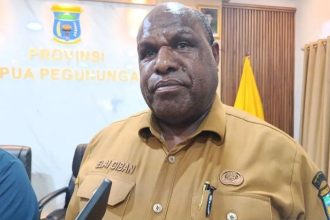

NABIRE – The Central Papua Provincial Government has officially launched the Governor’s Strategic Program, Bangun Generasi dan Keluarga yang Inklusif dan Tangguh (BANGKIT) (Building Inclusive and Resilient Generations and Families), as one of the flagship initiatives marking the province’s 4th Anniversary. The program is designed to improve community welfare by enhancing child nutrition, empowering families, and reducing poverty.
During the launch, Central Papua Governor Meki Nawipa announced that 1,000 children aged 0–4 years in Puncak Jaya, Intan Jaya, Dogiyai, and Paniai Regencies will receive Rp350,000 per month. The financial assistance is intended to support children’s nutritional needs during their critical growth period as part of the province’s long-term investment in human capital development.
In his remarks, Governor Nawipa said that the establishment of Central Papua as a new autonomous province has provided greater opportunities for the regional government to design development programs that better address the needs of local communities.
Reflecting on his tenure as Regent of Paniai, he recalled that each regency in the former Papua Province had to compete for provincial funding by presenting development proposals. According to him, that experience underscored the importance of creating policies that ensure more equitable development across all regions of Central Papua.
Governor Nawipa also explained that the success of the Paniai Elderly Program, implemented during his time as regent, inspired the development of the BANGKIT Program. He expressed hope that the initiative would accelerate regional development while improving the welfare of communities throughout the province.
He called on regency governments, regional government agencies (OPDs), and all sectors of society to work together to oversee the implementation of the program so that its benefits reach the intended recipients effectively.
According to the governor, the BANGKIT Program was developed in response to several key development challenges facing Central Papua. Government data indicate that the province’s stunting rate stands at approximately 32.5 percent, while the poverty rate is around 28.90 percent. He emphasized that strengthening data collection remains a priority to ensure that future policies are based on accurate and reliable information.
Governor Nawipa stressed the importance of support from local governments and village officials in updating data on poverty, stunting, and mortality so that development programs can be implemented more effectively and reach those most in need.
He further noted that the success of regional leadership should not be measured solely by infrastructure development but also by improvements in the Human Development Index (HDI) through better healthcare services, education, child nutrition, and increased household income.
Governor Nawipa also revealed that preparations for the BANGKIT Program involved extensive coordination with various stakeholders, including the central government and international partners, to strengthen support for the program’s implementation.
Following its official launch, the Central Papua Provincial Government plans to conduct broader public outreach to ensure communities understand the program’s eligibility criteria, assistance distribution mechanism, and long-term objectives. Concluding his remarks, Governor Nawipa emphasized that the BANGKIT Program has been incorporated into the Central Papua Regional Medium-Term Development Plan (RPJMD), providing a solid foundation for its long-term implementation throughout his administration alongside the Deputy Governor. The provincial government aims to begin distributing assistance to 1,000 children by the end of this year, marking the first phase of the program and a concrete step toward improving the quality of future generations in Central Papua.