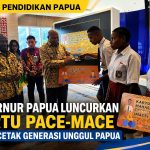
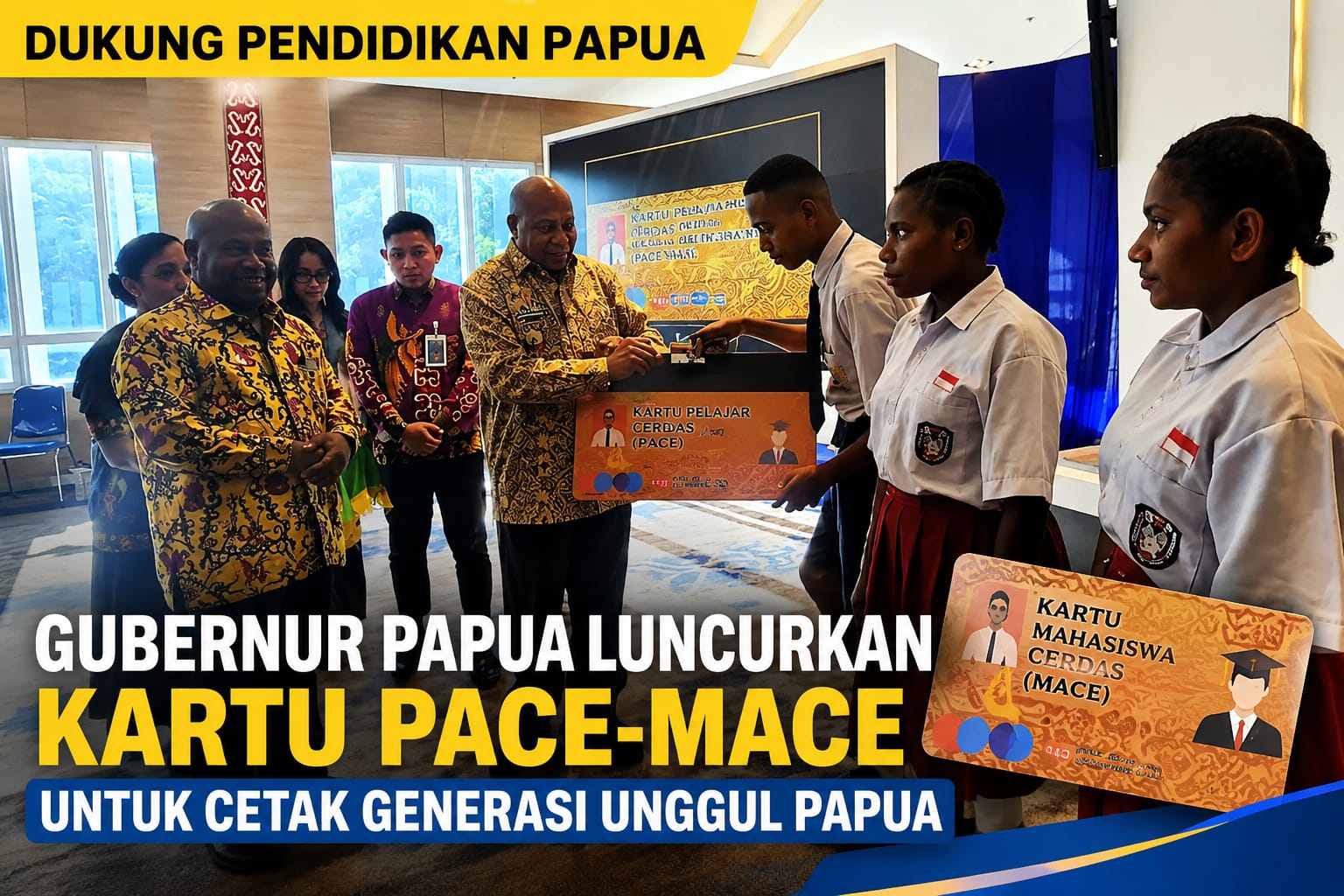
Jayapura, Papua – The Papua Provincial Government has launched the Pelajar Cerdas (PACE) and Mahasiswa Cerdas (MACE) cards, a new education support initiative aimed at expanding learning opportunities and strengthening human capital development across the province.
The program, officially introduced by Papua Governor Mathius D. Fakhiri in Jayapura on Friday, is designed to support students from secondary school through higher education, while preparing a new generation of skilled and competitive Papuans capable of contributing to the region’s long-term development.
Governor Fakhiri described the initiative as more than a financial assistance program, emphasizing that it represents a broader commitment to investing in Papua’s future through education.
“The launch of the PACE and MACE cards is not merely the introduction of an educational assistance program, but a commitment and a major movement to build a generation of Papuans who are intelligent, prosperous, and harmonious,” Fakhiri said.
According to the governor, sustainable development in Papua will depend not only on the region’s abundant natural resources but also on the quality of its human resources.
“Papua’s progress will not be determined solely by its natural wealth, but by the quality of the people who manage it. Therefore, human development will remain one of the Papua Provincial Government’s top priorities over the next five years,” he stated.
The PACE-MACE initiative has been designed as a long-term human development framework, supporting students throughout their educational journey and encouraging them to return and contribute to Papua’s development through various professions and sectors.
As part of the program, the provincial government also plans to provide special support for talented Papuan students seeking admission to Indonesia’s prestigious state academies and public service institutions, including the National Police Academy (Akpol), Military Academy (Akmil), Institute of Public Administration (IPDN), State Finance Polytechnic STAN, State Intelligence College (STIN), and the National Cyber and Crypto Polytechnic (Poltek SSN), among others.
The initiative is expected to complement and strengthen existing education and human resource development programs while promoting greater continuity, inclusiveness, and collaboration in educational policy.
Acting Head of the Papua Provincial Education Office, Marthen Medlama, explained that during the first phase of implementation, the PACE card will be distributed to students attending 12 schools under the authority of the provincial government, located across several regencies and municipalities.
Meanwhile, the MACE card will be provided to university students as part of broader efforts to increase educational access and strengthen human resource development throughout Papua.
“We hope these programs will become an important part of the regional government’s efforts to expand access to education and improve the quality of human resources in Papua,” Medlama said.
The launch of the PACE-MACE program reflects Papua’s growing emphasis on education as a foundation for inclusive development. By investing in students and young professionals, provincial leaders hope to create greater opportunities for future generations while fostering a skilled workforce capable of supporting the region’s social and economic transformation.
As Papua continues to address development challenges across its diverse and geographically complex landscape, education is increasingly being viewed as a key driver of long-term prosperity and sustainable growth.Versi ini menggunakan gaya yang biasa dipakai media internasional seperti Reuters, AP, atau The Jakarta Post English Edition: lebih fokus pada human development, opportunity, future generations, dan long-term development, sehingga lebih menarik bagi pembaca internasional yang mungkin tidak familiar dengan konteks Papua.