
NABIRE – The Nabire Regency Government in Central Papua, together with personnel from the Indonesian National Armed Forces (TNI) and the National Police (Polri), has intensified monitoring of public fuel stations (SPBU) to ensure that subsidized fuel distribution truly reaches the people who need it.
This effort reflects the local government’s commitment to responding to public concerns regarding the distribution of subsidized fuel so that it can be enjoyed fairly by residents who are entitled to it.
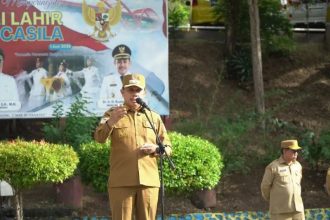
Assistant I of the Nabire Regional Secretariat, La Halim, stated that the monitoring is being carried out by a joint team through direct inspections at several fuel stations across the Nabire area.
“This activity follows the directive of the Regent of Nabire to ensure that subsidized fuel distribution runs according to regulations and is truly utilized by the community,” he said while leading an inspection at the Oyehe fuel station on Tuesday.
He explained that the monitoring activities are based on an official assignment letter issued by Nabire Regent Mesak Magai on March 9, 2026, as well as the Regent’s Instruction regarding the supervision of subsidized fuel distribution.
The joint team, consisting of representatives from the local government, the TNI, and the Polri, is scheduled to conduct inspections for three days by examining all six fuel stations that distribute subsidized fuel in Nabire Regency.
In addition to monitoring fuel distribution at the stations, officers are also checking vehicles refueling to ensure there is no misuse of subsidized fuel.
“We check vehicles that are refueling to make sure there are no modified fuel tanks, duplicate license plates, or inappropriate use of the MyPertamina barcode system,” he explained.
This monitoring effort is intended as a preventive measure to avoid fraudulent practices that could disadvantage the public, such as repeated refueling using different vehicle identities.
However, the government has assured residents that fuel stocks in Nabire Regency are currently sufficient, so the public does not need to worry about supply shortages.
“This monitoring aims to maintain fairness in the distribution of subsidized fuel so that it can truly be enjoyed by those who are entitled to it,” he added.
Meanwhile, the Sales Branch Manager for Central Papua 1 at PT Pertamina Patra Niaga, Muh Rinaldi Suryanto, explained that local governments have the authority to regulate the daily allocation of subsidized fuel per vehicle according to regional needs.
Nationally, the MyPertamina barcode system has three classifications for subsidized fuel allocation—60 liters, 80 liters, and 200 liters per vehicle—which can be adjusted by local governments based on geographic conditions and community needs.
During the inspection, the joint team also found several administrative violations, including vehicles with expired license plates, vehicles without registration certificates (STNK), and the use of inappropriate barcodes.
Going forward, the local government together with related security forces will continue to carry out persuasive and sustainable monitoring to ensure that the distribution of subsidized fuel remains orderly, transparent, and beneficial for the people of Nabire.