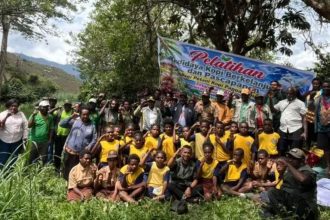
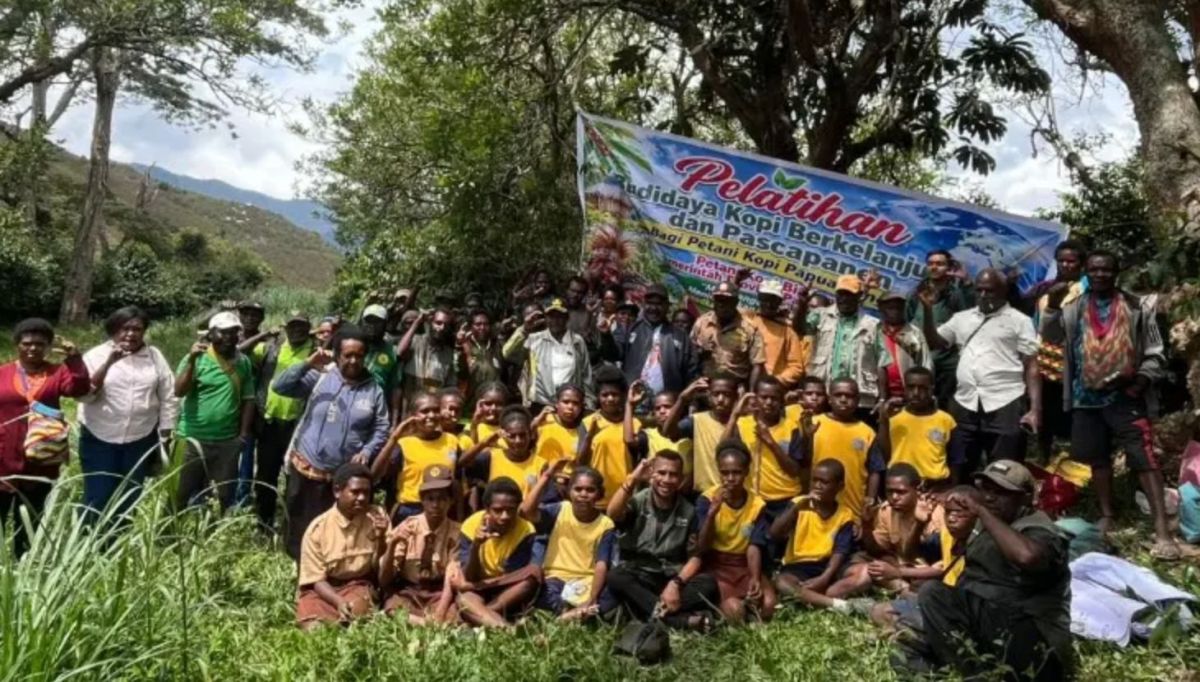
DOGIYAI, CENTRAL PAPUA – Efforts to revive the former glory of Moanemani coffee continue through initiatives to improve the knowledge, skills, and capabilities of local farmers. The Central Papua Provincial Government, in collaboration with the Sustainable Coffee Platform of Indonesia (SCOPI), held a training program for dozens of coffee farmers at the coffee plantation owned by SMP YPPK St. Francis Moanemani in Dogiyai Regency on Friday (November 20, 2026).
The initiative represents a strategic step toward revitalizing Dogiyai’s coffee plantation potential while strengthening the local economy through sustainable agricultural development.
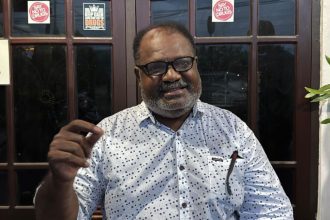
Head of the Plantation/Agriculture Division of the Central Papua Provincial Government, Andreas Gobai, called on farmers, government institutions, churches, and other stakeholders to unite in restoring the former prominence of Moanemani coffee. He emphasized that the region’s long-recognized coffee potential must be supported by hard work and serious, consistent plantation management.
He stressed that Moanemani coffee is more than just an agricultural commodity; it is also part of Dogiyai’s history, identity, and community pride, which must be preserved and developed by the current generation.
“As a son of this region, I personally appeal to all of us to work together to restore the former glory of Moanemani coffee,” Andreas said in his statement on Friday (November 20, 2026).
Andreas expressed his pride upon discovering that coffee enjoyed by consumers outside Papua actually originated from Moanemani. However, he noted that such pride must be demonstrated through productivity and tangible efforts by local farmers in their own region.
“We should not boast if we do not work. We cannot take pride in the results of other people’s hard work. You are not the master of your own land; instead, you become a mere spectator in your own hometown,” he firmly stated.
Furthermore, he reminded the community that Dogiyai’s natural resources and agricultural potential would not deliver maximum benefits unless properly managed. Therefore, the knowledge gained through the training program must be directly implemented in the plantations to improve coffee quality and production outcomes.
“We must be in the coffee plantations so that we can practice and work directly. This is no longer the time for endless talk; it is time for us to work,” he said.
He also acknowledged that the people of Dogiyai already possess basic experience in coffee cultivation. Nevertheless, continued improvements in knowledge and technical skills remain necessary to enable farmers to produce higher-quality coffee and strengthen its competitiveness in the market.
Andreas encouraged farmers to remain eager to learn, maintain their dedication, and stay open to new innovations in coffee plantation development.
“This is our land,” he added.
Through this training program, the Central Papua Provincial Government and SCOPI provided capacity-building support covering cultivation techniques, the selection of superior seedlings, and post-harvest handling. The knowledge gained is expected to be applied consistently to improve the quality and economic value of Moanemani coffee.
According to Andreas, reviving Moanemani coffee requires the active involvement of all stakeholders, not only the government but also farmers and the wider community as the key drivers of agricultural development.
“May this become a blessing for our land and for all of us. May we be willing to work, listen to one another, and remain committed to restoring the glory of Moanemani coffee through concrete efforts in our own plantations, for the welfare of farmers and the sustainable economic development of the Dogiyai community,” he concluded.
Through continuous training and assistance, Moanemani coffee is expected to regain its position as one of Dogiyai’s leading commodities, while creating opportunities to increase farmers’ income and welfare and strengthen the economy of communities throughout Central Papua.