Merauke, Papua – Indonesia’s Community Rice Field Development Program (Cetak Sawah Rakyat/CSR) continues to deliver tangible benefits in Papua by increasing agricultural productivity, strengthening regional food security, and improving the livelihoods of local farmers and Indigenous communities.
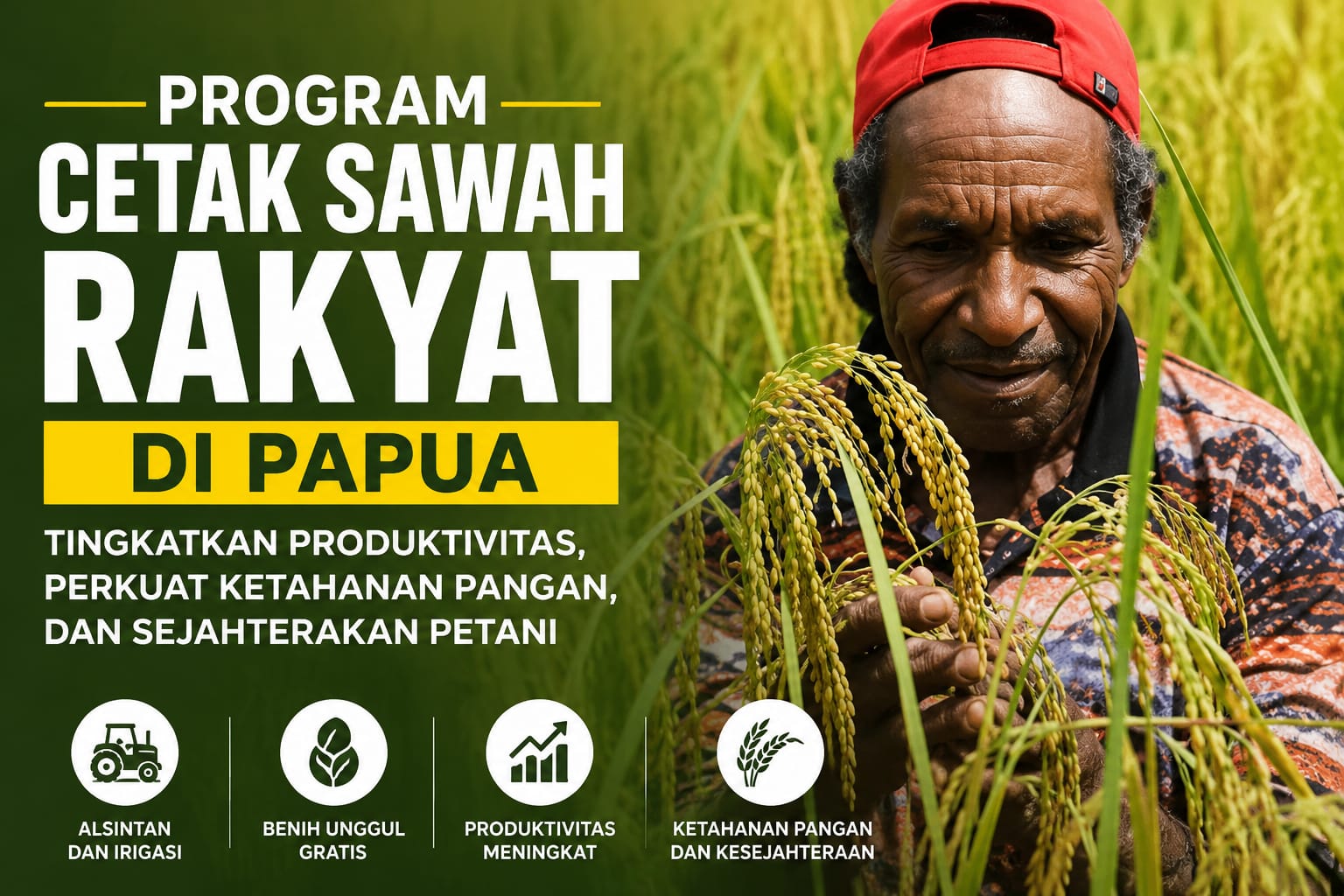
The program enables Indigenous landowners to cultivate their own land with government support, while maintaining full ownership and management rights. Through agricultural mechanization, irrigation infrastructure, high-quality seeds, and modern farming technology, farmers have been able to significantly improve production and expand economic opportunities.
Minister of Agriculture Andi Amran Sulaiman emphasized that agricultural development in Papua is aimed at achieving food self-sufficiency while improving the welfare of local communities. He said Papua’s food demand should increasingly be met through local production while continuing to develop the region’s traditional food resources.
“We want to build food self-sufficiency across every island, including Papua. Food for our brothers and sisters in Papua should be produced in Papua itself. Rice, sago, sweet potatoes, and other local food commodities must be developed together with local communities,” Minister Amran said.
He stressed that the Community Rice Field Development Program is not intended to take over community-owned land. Instead, the government provides support to Indigenous landowners by supplying agricultural machinery, irrigation systems, free certified seeds, and modern cultivation technology to maximize the productivity of their land.
“This is community-owned land. We provide tractors, irrigation, free seeds, and technology. The goal is to improve the welfare of our brothers and sisters in Papua and enable them to produce food for their own region,” he said.
The government reports that the program has begun to produce measurable results. Rice productivity has increased from around three tons per hectare to approximately seven tons per hectare. Cropping intensity has also improved from one planting season per year to as many as three, contributing to higher agricultural output and increased farmers’ incomes.
According to Minister Amran, these improvements are part of a broader strategy to strengthen Indonesia’s food security while creating new sources of economic growth for communities in Papua.
“If we do not start building now while the population continues to grow, where will our food come from? That is why we are investing in the sustainability of the Republic and the welfare of our brothers and sisters in Papua,” Amran stated.
The benefits of the program have also been acknowledged by Indigenous communities. Hermannus Mahuse, a customary landowner in Merauke, said the situation on the ground differs from narratives circulating outside Papua. According to him, Indigenous communities continue to own and manage their land, while the government provides assistance to help improve its productivity.
“The government is not clearing forests and taking our land. Instead, the government helps prepare our land so that we can manage it ourselves and enjoy the benefits ourselves,” Hermannus emphasized.
He added that the Community Rice Field Development Program, together with agricultural machinery assistance from the Ministry of Agriculture, has enabled Indigenous communities to adopt more modern and productive farming practices.
“The government has supported us through the Community Rice Field Development Program and by providing agricultural machinery. With this assistance, we are now able to cultivate 112 hectares of land. I truly appreciate it, and I am grateful for the government’s support,” he said.
The Community Rice Field Development Program has become one of Indonesia’s strategic initiatives to strengthen national food production while improving the welfare of Papua’s communities. By ensuring that land ownership remains with local people and complementing it with mechanization, superior seeds, irrigation, and modern agricultural technology, the program is helping farmers increase productivity, create broader economic opportunities, and build long-term food self-sufficiency from their own land.