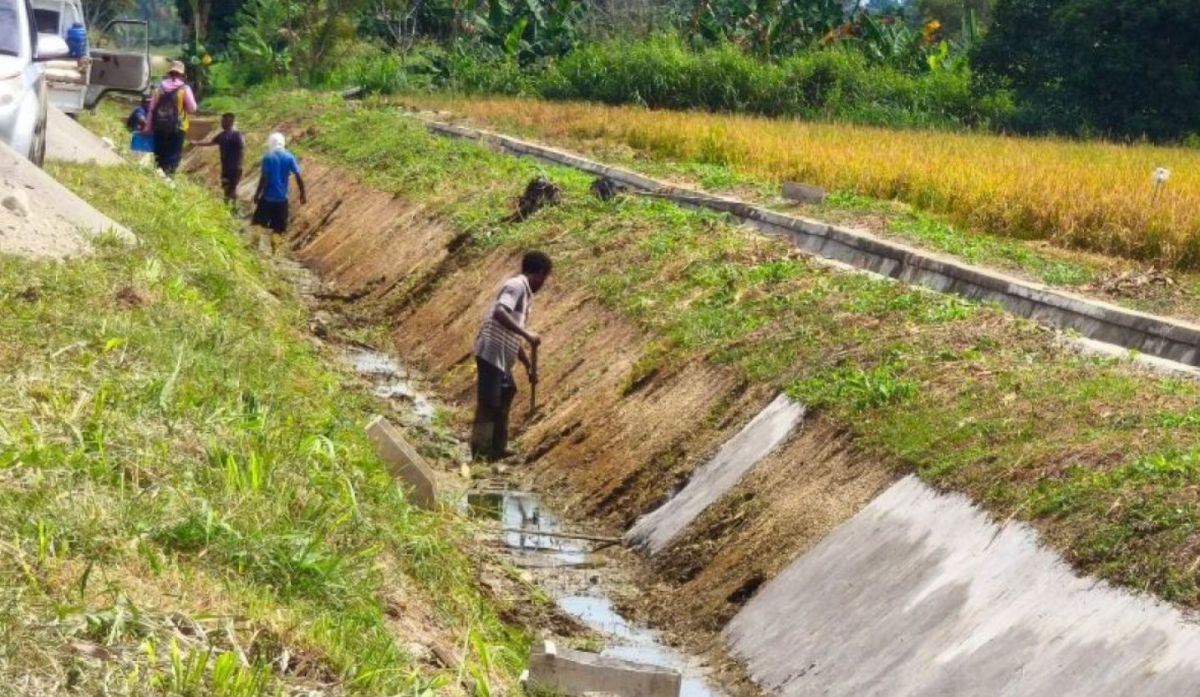
NABIRE, CENTRAL PAPUA – The Nabire Regency Government, through its Agriculture Office, has involved 25 farmer groups in a program to rehabilitate tertiary and quaternary irrigation networks across three districts, as part of efforts to improve water distribution to agricultural land.
Head of the Nabire Agriculture Office, Yasor Victor Sawo, said the program is supported by the Directorate General of Agricultural Infrastructure and Facilities at the Ministry of Agriculture and targets agricultural production centers in Makimi, West Nabire, and Wanggar districts.
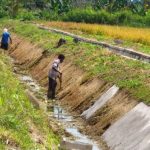
According to Yasor, the rehabilitation focuses on existing irrigation infrastructure, particularly damaged channels and water gates that require repairs.
“The main objective of this program is to optimize the existing irrigation network so that water can be properly distributed to farmers’ fields,” Yasor said in Nabire on Saturday.
As part of the implementation, farmer groups are not only beneficiaries but are also involved from the planning stage. Each group identifies the rehabilitation needs of its tertiary and quaternary irrigation networks based on field conditions and prepares a budget plan, which is then submitted to the Nabire Agriculture Office.
The Agriculture Office has also held coordination meetings to accelerate implementation, including preparations for prospective beneficiaries and locations (CPCL), as well as plans for the utilization of the irrigation networks by the farmer groups.
Yasor explained that funding for the program would be transferred directly to the farmer groups’ bank accounts. The amount allocated to each group has yet to be determined, as it will depend on the budget plans prepared according to the type and extent of damage and the rehabilitation needs identified in the field.
“The amount of funding has not yet been determined because each farmer group is still preparing its budget plan based on the rehabilitation needs they have identified,” he said.
Meanwhile, rehabilitation of the primary and secondary irrigation networks in Kalibumi, West Nabire District, is also underway and is being carried out by the Papua River Basin Organization (BWS Papua) in accordance with its authority.
The work is targeted for completion and trial operation on Monday (September 14). The trial is intended to ensure that water can once again flow properly from the main irrigation network to the subsequent distribution channels.
The Nabire Agriculture Office expects the restoration of the primary and secondary irrigation networks to directly support agricultural activities, particularly rice cultivation and development in the Kalibumi area.
“Once the primary and secondary networks are completed, farmers can immediately proceed with the development or rehabilitation of the tertiary and quaternary networks so that water can be distributed evenly to their fields,” Yasor said.
Previously, BWS Papua carried out the rehabilitation of a 2.8-kilometer primary irrigation channel at the Kali Bumi Weir. The project aims to restore the reliability of an irrigation network that had not undergone major repairs for years.
The rehabilitation covers the channel from Control Building (BK) 0 to BK1, which serves as the main section before the water is distributed to the secondary irrigation network.
The work begins at the sand trap structure, which collects sediment near the Kali Bumi Weir, and extends to Control Building 1, covering a total channel length of 2.8 kilometers.
Through the gradual rehabilitation of irrigation infrastructure, from primary networks to tertiary and quaternary networks, the government hopes to ensure a more reliable water supply for agricultural land in Nabire and support the sustainability of local food production.