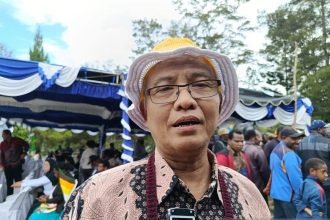

Papua – Udayana University (Unud) political observer, Efatha Duarte, emphasized that Papua’s status as part of Indonesia has a strong basis in international law and cannot be debated. This is because the integration process aligns with the doctrine of uti possidetis iuris (a new nation inherits territorial boundaries from its previous colonial administration), which is a norm in modern international law.
This doctrine, she explained, has even been considered by the International Court of Justice in deciding various territorial disputes between countries. One such dispute was between Burkina Faso and Mali in 1986.
Efatha continued, explaining that at the 1949 Round Table Conference (RTC), the Netherlands recognized Indonesian sovereignty no later than December 30, 1949. Thus, all former Dutch East Indies colonies, including Papua, became Indonesian territory. This status was later reinforced through the 1962 New York Agreement involving Indonesia, the Netherlands, and the United Nations.
“UN General Assembly Resolution 2504 of 1969 recognized the results of the Act of Free Choice (Pepera), thus formally completing the decolonization process of Papua,” he said on Friday (April 24, 2026).
Based on the principle of pacta sunt servanda in the 1969 Vienna Convention, Efatha added, all international agreements are binding and final. Therefore, the narrative that Papua was the result of annexation is a fundamental error in understanding international law.
Furthermore, he alluded to Amitai Etzioni’s theory of political integration in “Political Unification” (1965). It states that integration is a gradual process involving the formation of collective identity, the distribution of power, and ongoing political participation.
“Post-1969, Papua demonstrated characteristics of integration, such as the formation of regional governments (pemda), representation in the House of Representatives (DPR), and special autonomy policies (otsus) through Law Number 21 of 2001, which was updated to Law Number 2 of 2021,” he explained.
According to Efatha, integration is fundamentally different from annexation. From an international legal perspective, annexation is a unilateral act accompanied by domination without public participation.
“Papua, on the other hand, demonstrates a real space for dialogue, political representation, and co-governance. This confirms that integration and annexation are on different spectrums,” he concluded.