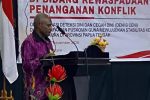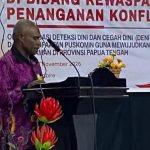
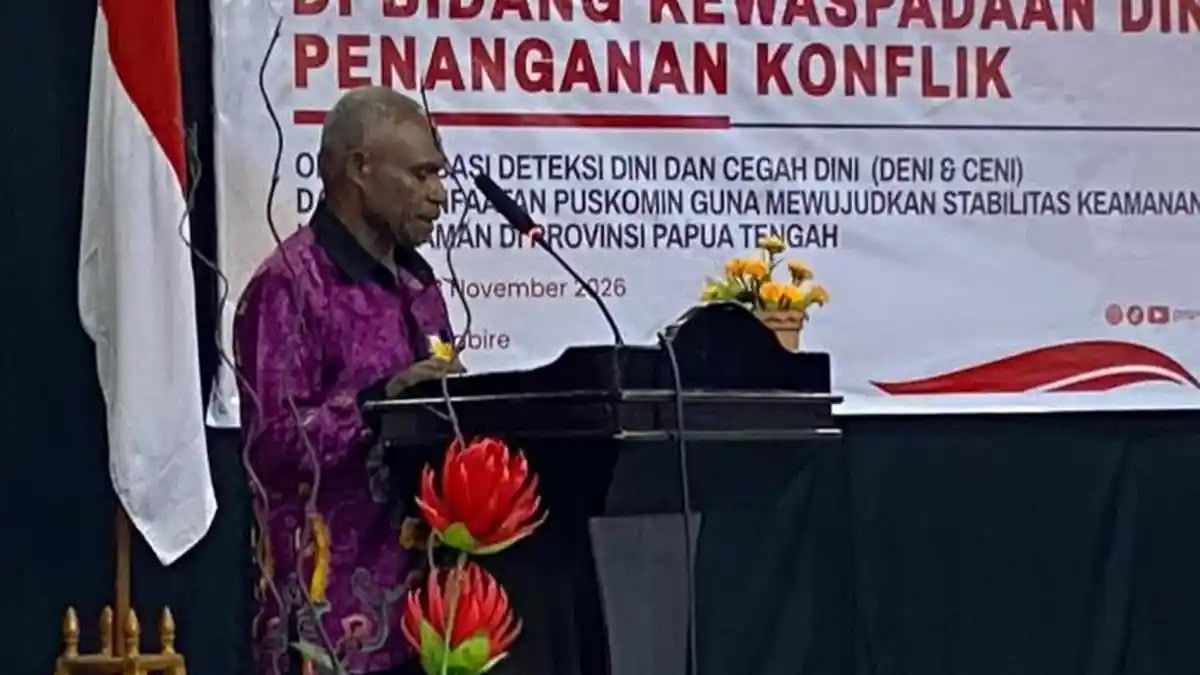
NABIRE – The National Unity and Political Agency (Kesbangpol) of Central Papua Province held a capacity-building session for government personnel, aimed at strengthening early detection and conflict prevention systems in the region. The event took place on Friday (November 13, 2026) at the RRI Nabire Hall, located on Jalan Merdeka, Nabire District, Nabire Regency.
The initiative was designed to equip government officials with a comprehensive understanding of the importance of maintaining public peace and order.
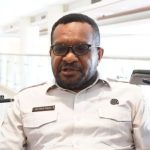
Andreas Nawipa, Head of the National Vigilance and Conflict Management Division at the Central Papua Province National Unity and Political Agency, explained that enhancing human resource capacity is a strategic step toward making officials more attuned to identifying potential threats, challenges, obstacles, and disruptions (ATHG).
“Capacity building is a crucial step in strengthening the ability of officials to identify potential threats, challenges, obstacles, and disruptions, as well as to develop a more effective reporting system,” Andreas stated in his remarks.
In addition to improving field analysis, the session focused on the use of technology—specifically the Communication and Information Center (Puskomin) application developed by the Ministry of Home Affairs.
Through this application, officials are expected to be able to input and submit reports on incidents or strategic issues in a manner that is fast, accurate, and integrated.
According to Andreas, this initiative also aims to align perspectives and strengthen coordination channels between the Central Papua Provincial Government and the central government regarding the management of social conflicts.
“To provide in-depth insights, the committee invited two qualified speakers from the Ministry of Home Affairs’ Directorate General of Politics and General Governance: Timotius, Acting Head of the Sub-directorate for Early Vigilance and Intelligence Cooperation, and Abrar Afif from the Directorate of National Vigilance,” he said. The speakers provided strategic policy guidance on strengthening regional early warning systems and mechanisms for handling social conflicts, alongside technical training on the use of the Puskomin application-based data system.
Through this initiative, Andreas hopes to produce an initial analysis and inventory document regarding potential vulnerabilities in Central Papua. He noted that this document will serve as a crucial reference for leadership in formulating preventive policies.
“By combining enhanced staff competency with the use of modern reporting technology, the functions of national vigilance and conflict management can be optimized to maintain stability and public security in Central Papua,” he concluded.
For context, the event—attended by officials, civil servants (ASN), and non-civil servant staff from the Central Papua National Unity and Politics Agency (Kesbangpol)—was conducted in a hybrid format, combining both online and in-person participation.
The activity is grounded in applicable regulations, including Law Number 7 of 2012 concerning the Handling of Social Conflicts, Law Number 15 of 2022 concerning the Establishment of Central Papua Province, and Central Papua Governor Regulation Number 59 of 2024 concerning the Implementation of Early Warning Systems.