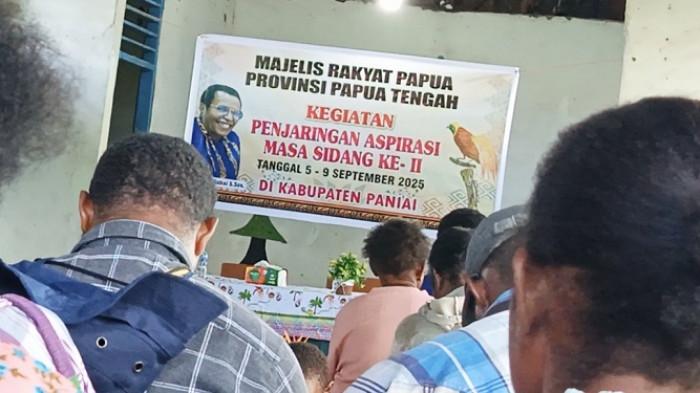
NABIRE – The Religious Working Group (Pokja Agama) of the Papua Tengah Papuan People’s Assembly (MRP) held a series of aspiration-gathering activities in Nabire from September 5–9, 2025.
The agenda aimed to directly capture input from the community, particularly concerning the protection of the rights of Indigenous Papuans (OAP).
Maria Gobai, a member of the Papua Tengah MRP Religious Working Group, revealed that eight key points of aspiration were collected from representatives of women, youth, students, and market vendors.
These eight points cover politics and governance, economy, socio-cultural affairs, education, health, human rights, women and children, as well as social issues faced by young people.
From all the input received, Gobai highlighted three major issues most frequently raised.
“The biggest issue we found was social problems, especially the circulation of alcoholic beverages,” she said at the St. Stefanus Catholic Church Hall, Kampungbou Street, Kota Lama, Morgo Village, Nabire District, Central Papua.
She added that other significant concerns include the difficulties faced by Papuan women in accessing markets, and the lack of local content in school education that aligns with the conditions of Indigenous Papuans.
Gobai stressed that the MRP will fight for these aspirations before both regional and central governments.
“We hope the people’s voices can be accommodated and followed up in order to realize justice for Indigenous Papuans,” she explained.
A participant representative, Lince Giyai, who also serves as Chairwoman of the Indonesian Catholic Women’s Association (WKRI) Christ Our Friend (KSK), expressed her appreciation for the presence of the MRP.
According to her, social issues such as the widespread circulation of alcohol and drugs have triggered rising crime rates as well as the spread of HIV/AIDS.
Therefore, she urged both provincial and district governments to promptly follow up on the results of this aspiration-gathering.
“We hope these aspirations can serve as a foundation for the issuance of regional regulations (perda) to restrict the circulation of alcoholic beverages, in order to save Papua’s younger generation,” Giyai concluded.